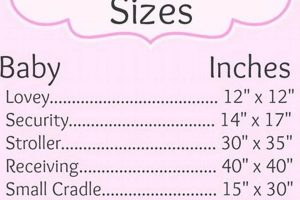
The appropriate dimensions of a blanket intended for infant use are crucial for safety and functionality. These dimensions typically range, on the shorter side, from 30 to 36 inches, and on the longer side, from 36 to 45 inches. This size allows for swaddling, covering in a stroller, or use as a small playmat, depending on the specific need and activity.
Selecting suitable dimensions for an infant’s blanket carries implications for the child’s well-being. Blankets that are excessively large present potential hazards, such as suffocation or entanglement. Conversely, a blanket that is too small may not provide adequate warmth or coverage. Historically, concerns about Sudden Infant Death Syndrome (SIDS) have underscored the importance of adhering to safe sleep practices, including selecting appropriately sized bedding.
Considerations beyond the overall length include the material used, the tightness of the weave, and any embellishments that could pose a risk. The following sections will delve into specific size recommendations for various blanket types, factors influencing the selection process, and tips for ensuring safe usage practices.
Sizing Guidelines for Infant Blankets
Optimal sizing contributes significantly to an infant’s comfort and safety. Adherence to these guidelines mitigates potential risks and enhances the blanket’s utility.
Tip 1: Prioritize Safety Over Size: Avoid blankets that exceed 45 inches in length or width. Overly large dimensions present a greater entanglement hazard.
Tip 2: Consider the Intended Use: A blanket intended primarily for swaddling may require a larger square footage than one designed solely for stroller use.
Tip 3: Account for Shrinkage: Pre-wash fabrics prior to construction to minimize post-production shrinkage. Adjust initial dimensions accordingly.
Tip 4: Verify Weave Density: Opt for tightly woven fabrics to prevent loose threads or loops that could pose a strangulation risk.
Tip 5: Exclude Embellishments: Refrain from adding buttons, ribbons, or other decorative elements that could detach and become a choking hazard.
Tip 6: Adapt to Growth: As the infant grows, reassess the blanket’s suitability. Transition to larger bedding options when the initial blanket no longer provides adequate coverage without posing a risk.
Tip 7: Consult Pediatric Recommendations: Pediatricians and child safety organizations provide up-to-date guidance on safe sleep practices, including blanket sizing.
Following these guidelines promotes a secure environment for the infant. Careful attention to detail when selecting or creating an infant blanket minimizes potential risks and contributes to overall well-being.
The subsequent section will address material choices and their impact on safety and suitability.
1. Safety Implications

The dimensions of an infant blanket directly correlate with potential safety hazards. A blanket exceeding recommended lengths and widths, typically above 45 inches, increases the risk of suffocation or entanglement. An overly large blanket can easily cover an infant’s face, impeding breathing, especially during sleep. The excess fabric also presents opportunities for the infant to become wrapped or trapped, restricting movement and potentially leading to distress or injury. The correlation is causal: increased blanket size demonstrably increases the probability of adverse safety outcomes. Examples, documented in pediatric medical literature, detail instances of infants becoming entangled in excessively large blankets, resulting in compromised respiratory function.
Conversely, a blanket deemed too small, although less likely to pose direct suffocation risks, may not provide adequate warmth, potentially leading to discomfort or hypothermia in colder environments. However, the primary concern remains the avoidance of entanglement. Therefore, establishing appropriate maximum dimensions is paramount. Adhering to specified size limits mitigates the risk of airway obstruction and physical entrapment, ensuring the blanket fulfills its intended purpose without jeopardizing infant safety. Practical application involves routinely assessing blanket size relative to the infant’s growth and discarding or repurposing the blanket when it exceeds safe proportions.
In summary, the relationship between blanket dimensions and safety is linear: as blanket size increases beyond recommended parameters, the risk of adverse safety events escalates. Understanding this relationship is crucial for caregivers and manufacturers alike. Challenges involve continually educating consumers on evolving safety recommendations and enforcing stringent manufacturing standards. Ultimately, emphasizing safe blanket dimensions contributes to a reduction in infant mortality and morbidity associated with unsafe sleep environments.
2. Swaddling Needs

Swaddling, an age-old practice, requires specific blanket dimensions to effectively restrain an infant’s movements, promoting sleep and reducing anxiety. The relationship between swaddling needs and appropriate blanket length is direct; an insufficient length compromises the swaddle’s effectiveness, while excessive length introduces safety hazards.
- Full Body Enclosure
Effective swaddling necessitates a blanket length sufficient to fully encompass the infant’s torso and limbs, from shoulders to feet. This complete enclosure mimics the feeling of being held, calming the infant and preventing startle reflexes from disrupting sleep. For example, a blanket shorter than 36 inches may fail to secure the infant’s arms, rendering the swaddle ineffective and potentially leading to agitation. Conversely, a blanket extending beyond 45 inches presents an excess of material, increasing the risk of the blanket unraveling and obstructing the infant’s airway.
- Secure Limb Immobilization
One primary purpose of swaddling is to restrict the infant’s arm movements. The blanket’s length must accommodate the wrapping and tucking of the arms close to the body, minimizing involuntary movements. An inadequate length may allow the infant to break free from the swaddle, negating its intended calming effect. Illustration: If the blanket does not reach sufficiently around the infant’s torso, the arms can easily escape, defeating the purpose of the swaddle and increasing the likelihood of self-inflicted scratches.
- Hip Positioning
Correct swaddling technique ensures the infant’s hips remain in a naturally flexed position, allowing for healthy hip development. A properly sized blanket facilitates this positioning by providing adequate room around the legs while maintaining a snug fit around the torso. Conversely, a blanket that is too tight or restrictive around the legs can force the hips into an unnatural position, potentially increasing the risk of hip dysplasia. Therefore, the blanket must be long enough to allow for free movement of the legs within the swaddle, preventing over-extension and strain on the hip joints.
- Proper Tucking and Security
The blanket’s length influences the security and durability of the swaddle. A sufficient length permits secure tucking of the blanket’s edges beneath the infant, preventing unraveling throughout the sleep period. A blanket with limited length may result in loose ends that pose a safety risk or allow the infant to easily escape the swaddle. Example: A blanket reaching only to the mid-torso may not provide enough material for secure tucking, leading to a loose and ineffective swaddle, particularly as the infant wriggles. Conversely, an excessively long blanket necessitates additional folds and tucks, creating bulk and potentially leading to overheating.
In summary, the ideal length for a swaddling blanket directly correlates to its ability to provide full body enclosure, secure limb immobilization, promote healthy hip positioning, and ensure secure tucking. Deviation from recommended lengths compromises the swaddle’s effectiveness and introduces potential safety risks. Therefore, caregivers must carefully consider swaddling needs when determining the appropriate dimensions of an infant’s blanket.
3. Stroller usage

The employment of infant blankets within strollers necessitates careful consideration of dimensions to ensure both comfort and safety. Stroller usage introduces unique spatial constraints and environmental factors that influence the optimal blanket length.
- Adequate Coverage within Confined Space
Blankets intended for stroller use must provide sufficient coverage to protect the infant from weather elements such as wind, sun, and light rain. However, the confined dimensions of a stroller dictate that the blanket should not be excessively long, preventing entanglement with the wheels or dragging on the ground. For instance, a blanket exceeding 40 inches in length may prove cumbersome and potentially hazardous within a standard stroller. The goal is to achieve optimal coverage without introducing unnecessary length that could compromise safety or maneuverability.
- Ventilation Considerations
When utilizing a blanket in a stroller, maintaining adequate ventilation is crucial to prevent overheating. A blanket that is too large can restrict airflow, creating a potentially dangerous environment, particularly in warmer climates. Therefore, the length should be proportionate to the stroller’s canopy and ventilation openings, allowing for sufficient air circulation around the infant. A compact blanket that covers only the lower half of the infant’s body allows for adequate airflow while still providing warmth and protection from the elements.
- Secure Attachment and Prevention of Dislodgement
Blankets deployed in strollers are susceptible to being dislodged by wind or infant movement. A blanket with excessive length may easily fall out of the stroller, potentially becoming contaminated or lost. Utilizing a blanket with appropriate dimensions, coupled with stroller clips or similar attachments, ensures secure placement and minimizes the risk of dislodgement. The blanket’s length should allow for secure fastening without creating excessive bulk that could impede stroller functionality.
- Accessibility for Caregivers
The blanket’s length should not impede the caregiver’s ability to readily access the infant. A blanket that is excessively long may necessitate cumbersome lifting or rearranging to check on the infant or provide immediate care. The ideal length allows for quick and easy access while still providing adequate coverage. Practical example: A blanket that extends beyond the stroller’s footrest may require the caregiver to lift the entire blanket to access the infant, potentially disrupting the child’s sleep or causing discomfort.
In conclusion, optimizing blanket length for stroller usage balances adequate coverage with safety, ventilation, security, and accessibility considerations. The unique spatial constraints of strollers necessitate a more compact blanket size compared to those used for swaddling or cribs. Therefore, caregivers should carefully assess stroller dimensions and environmental conditions when selecting an infant blanket.
4. Material Shrinkage
Material shrinkage exerts a direct influence on the determination of appropriate blanket dimensions, particularly for infant use. Textiles, especially natural fibers such as cotton and wool, are susceptible to dimensional changes during washing and drying processes. This shrinkage, if unaccounted for, can result in a finished blanket significantly smaller than the intended size, compromising its functionality and potentially affecting its safety. For example, a blanket initially cut to 36 inches may shrink to 33 inches after washing, reducing its effectiveness for swaddling or providing adequate coverage in a stroller. The degree of shrinkage varies depending on the fiber content, weave structure, and finishing processes applied to the fabric. High-shrinkage materials, therefore, necessitate a greater allowance during the initial cutting and sewing stages.
The practical significance of understanding and mitigating material shrinkage lies in ensuring the blanket retains its intended dimensions and performance characteristics after repeated laundering. Pre-washing fabrics before cutting and sewing is a widely adopted practice to minimize post-production shrinkage. This step, although seemingly simple, allows the fabric to undergo its initial dimensional change before being incorporated into the final product. By accounting for shrinkage during the design and construction phases, manufacturers and crafters can produce blankets that consistently meet specified size requirements, providing reliable and predictable performance. Inaccurate assessment of shrinkage can lead to inconsistencies in blanket size, impacting customer satisfaction and potentially raising safety concerns if the blanket becomes too small for its intended purpose.
In summary, material shrinkage represents a critical factor in determining appropriate infant blanket dimensions. Neglecting to account for this phenomenon can result in under-sized blankets with diminished functionality. Strategies such as pre-washing fabrics and incorporating shrinkage allowances into initial cutting calculations are essential to producing blankets that retain their intended size and performance characteristics throughout their lifespan. Challenges persist in accurately predicting shrinkage rates for diverse textile types, underscoring the importance of thorough testing and diligent quality control procedures. The connection between material shrinkage and finished blanket size is inextricable, emphasizing the need for meticulous attention to fabric properties during the design and manufacturing process.
5. Growth adjustments

The selection of an infant blanket’s dimensions necessitates ongoing assessment relative to the child’s physical development. Initial blanket sizes, appropriate for newborns, become inadequate and potentially unsafe as the infant grows. This is a direct consequence of the increasing risk of entanglement or restriction of movement as the child surpasses the blanket’s intended size parameters. For instance, a blanket initially sized at 30 inches in length may comfortably swaddle a newborn, but become restrictive and pose a potential hazard for a six-month-old infant capable of more significant movement. Consequently, adherence to blanket length recommendations requires iterative evaluation and adjustment based on the infant’s growth trajectory.
Practical application of growth adjustments involves regular monitoring of the infant’s interaction with the blanket. Caregivers should observe whether the blanket consistently covers the child adequately without causing constriction or posing a risk of entanglement. As the child’s length increases, a larger blanket or alternative sleepwear, such as a sleep sack, may become necessary. The transition to larger bedding options mitigates the risks associated with undersized blankets while still providing warmth and comfort. This transition is not a one-time event but rather a continuous process driven by the child’s evolving physical needs. Examples of this adaptation include switching from a swaddling blanket to a larger, unrestrictive blanket or opting for wearable blankets as the infant becomes more mobile.
In conclusion, the relationship between an infant’s growth and the appropriate blanket length is dynamic and requires proactive adjustments. Failure to adapt blanket size to the child’s increasing dimensions can compromise safety and comfort. Continuous assessment, coupled with timely transitions to larger or alternative bedding solutions, is crucial to ensure a secure and nurturing sleep environment. The challenge lies in educating caregivers about the importance of these adjustments and providing clear guidelines for selecting safe bedding options throughout the infant’s developmental stages. Understanding this interplay is fundamental to responsible infant care practices.
6. Weave density

Weave density, a measure of the closeness of threads in a fabric, significantly influences the functionality and safety considerations relevant to the appropriate dimensions of an infant blanket.
- Breathability and Suffocation Risk
Higher weave densities, characterized by tightly packed threads, reduce fabric permeability and limit airflow. Conversely, lower weave densities allow for greater air circulation. For an infant blanket, a very high weave density, especially in conjunction with an excessively large blanket, elevates the risk of suffocation if the fabric covers the infant’s face. Consequently, considering weave density is crucial when determining the overall size; denser weaves necessitate smaller blanket dimensions to mitigate potential suffocation hazards. A loose weave may allow an infant to breathe through the fabric, even if it covers the nose and mouth.
- Entrapment of Limbs and Toes
Loosely woven fabrics, while promoting breathability, can present a risk of limb entrapment. An infant’s fingers or toes could become caught in the gaps between threads, potentially leading to discomfort, injury, or restricted circulation. Therefore, an extremely loose weave, while potentially safer from a suffocation standpoint, necessitates vigilant monitoring and may warrant smaller blanket dimensions to reduce the likelihood of entrapment. An example: A loosely woven receiving blanket has potential to wrap tightly around an infant’s fingers.
- Thermal Properties and Insulation
Weave density influences the thermal properties of a blanket. Denser weaves generally provide greater insulation due to reduced air permeability, trapping more heat. However, excessive insulation can lead to overheating, particularly in infants who have limited capacity to regulate their body temperature. When selecting blanket dimensions, particularly for colder climates, weave density should be considered in conjunction with the blanket’s overall size to ensure adequate warmth without posing a risk of overheating. A very dense weave may not be suitable for summer months.
- Durability and Dimensional Stability
Higher weave densities typically result in more durable fabrics with greater dimensional stability. These fabrics are less prone to stretching or distorting, which can impact the blanket’s overall size and shape over time. While a higher weave density generally contributes to a longer-lasting blanket, the primary concern for infant use remains safety. The need for durability and stability should be balanced against the potential hazards associated with restricted airflow or limb entrapment. Blanket dimensions should be chosen in consideration to the risk of fabric degradation.
The interconnection between weave density and the appropriate length hinges on a holistic assessment of safety, thermal regulation, and fabric integrity. Consideration of weave density informs the decision-making process of optimizing blanket dimensions to promote a secure and comfortable environment for the infant. Blanket size should always be prioritized around breathability and entanglement issues; however, considering the weave density is an important factor in those decisions.
7. Pediatric guidelines

Pediatric guidelines represent a critical framework for establishing safe sleep practices for infants, directly informing recommendations for infant blanket dimensions. These guidelines, developed by organizations such as the American Academy of Pediatrics (AAP), emphasize minimizing risks associated with Sudden Infant Death Syndrome (SIDS) and other sleep-related infant mortalities. Therefore, adhering to these guidelines is paramount when determining appropriate blanket length.
- Safe Sleep Environment Emphasis
The AAP promotes a safe sleep environment characterized by a firm sleep surface, the absence of loose bedding, and the infant sleeping on their back. This recommendation inherently limits the use of blankets, regardless of size, particularly in younger infants. When a blanket is deemed necessary, pediatric guidelines suggest keeping it small and tightly tucked, reaching no higher than the infant’s chest, to minimize the risk of suffocation or entanglement. The blankets dimensions, therefore, become a critical aspect of complying with this core tenet of safe sleep practices. Any blanket exceeding these dimensional constraints directly contradicts the AAP’s safe sleep recommendations.
- Minimizing Suffocation and Entrapment Hazards
Pediatric recommendations explicitly address the hazards of loose bedding, including blankets, which can obstruct an infant’s airway or lead to entrapment. An infants limited motor skills and inability to remove an obstructing blanket necessitate strict adherence to size and placement guidelines. Blankets that are excessively long increase the probability of the blanket covering the infants face, impeding respiration. Guidelines often specify maximum blanket dimensions to mitigate this risk, advocating for blankets that are easily manageable and less likely to pose a suffocation threat. The length and width constraints advised in these guidelines directly reduce the potential for airway obstruction.
- Age-Specific Recommendations
Pediatric guidelines recognize that the appropriateness of blanket use, and therefore the relevance of specific dimensions, varies with infant age and developmental stage. For newborns and young infants, the emphasis is on avoiding blankets altogether due to the elevated risk of SIDS. As the infant develops increased head control and mobility, the use of a small, lightweight blanket may be considered, provided it adheres to strict size and placement protocols. Pediatricians provide age-specific advice on when and how to introduce a blanket, aligning recommendations with the infant’s evolving capabilities and risk profile. These individualized recommendations highlight the importance of continuous assessment rather than a one-size-fits-all approach.
- Evidence-Based Approach
Pediatric guidelines are rooted in extensive research and data analysis on infant sleep safety. Recommendations regarding blanket use and dimensions are informed by studies that have identified specific risk factors for SIDS and other sleep-related deaths. The guidelines are regularly updated as new evidence emerges, reflecting a commitment to incorporating the latest scientific findings into clinical practice. Clinicians reference these evidence-based guidelines when advising parents on creating a safe sleep environment, including the selection of appropriately sized blankets. The empirical basis of these guidelines underscores their authority and reliability in promoting infant well-being.
In summary, pediatric guidelines provide a comprehensive framework for safe infant sleep practices, directly influencing the determination of appropriate blanket length. Emphasis on a safe sleep environment, minimizing suffocation hazards, age-specific recommendations, and an evidence-based approach collectively inform the selection of blanket dimensions that prioritize infant well-being. These guidelines serve as a crucial resource for caregivers and healthcare professionals seeking to create a secure sleep environment, underscoring the vital connection between pediatric recommendations and blanket size considerations.
Frequently Asked Questions
The following addresses common inquiries regarding appropriate sizing for blankets intended for infant use. The information provided aims to clarify safety considerations and provide practical guidance.
Question 1: What constitutes a hazardous blanket length for an infant?
A blanket exceeding 45 inches in either length or width presents an elevated risk of entanglement and potential airway obstruction. Such dimensions increase the likelihood of the blanket covering the infant’s face, particularly during unsupervised sleep.
Question 2: Does the ideal blanket length vary based on the infant’s age?
Yes, blanket size appropriateness is directly correlated with the infant’s age and developmental stage. While smaller blankets may suffice for newborns, larger dimensions become necessary as the infant grows, provided safety precautions are observed.
Question 3: How does the intended use influence the determination of appropriate dimensions?
Blankets designed for swaddling typically require greater square footage than those used exclusively in strollers. Swaddling demands sufficient material to securely wrap the infant, whereas stroller blankets prioritize portability and minimizing excess fabric.
Question 4: What role does fabric shrinkage play in determining the initial cutting dimensions?
Anticipated shrinkage necessitates an increase in the initial cutting dimensions. Pre-washing fabrics is a prudent step to mitigate post-production shrinkage, ensuring the finished blanket meets specified size requirements.
Question 5: How does weave density impact safety considerations related to blanket length?
Denser weaves, while potentially warmer, can restrict airflow. For larger blankets, denser weaves increase the suffocation risk. Looser weaves, conversely, may pose entanglement hazards for fingers and toes. Blanket dimensions should be chosen to reflect this interplay.
Question 6: Where can reliable guidance be obtained regarding safe blanket dimensions for infants?
Organizations such as the American Academy of Pediatrics (AAP) provide evidence-based recommendations on safe sleep practices, including guidelines on appropriate blanket size. Consultation with pediatricians is also advisable.
Accurate assessment and careful consideration of blanket dimensions are vital for infant safety and well-being. Deviation from recommended guidelines can introduce significant risks.
The subsequent sections will focus on best practices for cleaning and maintaining infant blankets to ensure their longevity and continued safety.
Conclusion
The preceding discussion has articulated the multifaceted considerations inherent in determining suitable dimensions. Factors ranging from safety implications and swaddling requirements to material shrinkage and pediatric recommendations exert influence. Optimizing this key aspect necessitates a holistic assessment, prioritizing infant well-being above aesthetic preferences or convenience.
The persistent risk of sleep-related infant mortality underscores the gravity of informed decision-making. Continued adherence to established guidelines and proactive adaptation to the child’s developmental trajectory are essential. The ultimate objective remains fostering a secure and nurturing sleep environment, predicated on a thorough understanding of appropriate bedding parameters.