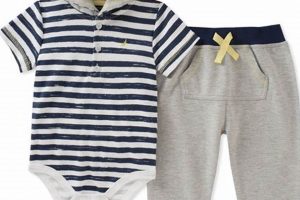
The numerical designation “80” in the context of infant apparel sizing generally refers to garments designed for children approximately 9 to 12 months old, or those measuring around 80 centimeters in height. This sizing convention is commonly employed in European and Asian markets, providing an alternative to age-based sizing systems often used in North America. For example, a garment labeled with this number typically accommodates an infant nearing their first birthday.
Correctly sizing infant clothing is important for comfort, mobility, and safety. Apparel that fits well allows for unrestricted movement, crucial for development. Garments that are too large can pose hazards, while those that are too small can restrict circulation and cause discomfort. The historical context of such sizing systems reflects an attempt to standardize clothing production and consumer understanding across diverse populations with varying growth patterns.
Understanding this numerical sizing is fundamental when selecting appropriate attire for infants. Further discussion will explore the measurement specifics, material considerations, and care instructions relevant to infant clothing, ensuring informed purchasing decisions.
Tips Regarding Size 80 Infant Apparel
The following recommendations aim to provide clarity when selecting size 80 clothing for infants, ensuring a suitable fit and maximizing garment longevity.
Tip 1: Verify Height Measurement. Confirm the infant’s height is within the approximate 80-centimeter range before purchasing. This measurement offers a more accurate indication than age alone, as growth rates vary.
Tip 2: Consult Size Charts. Different manufacturers may have slight variations in sizing. Refer to the specific brand’s size chart to ensure accurate selection.
Tip 3: Consider Garment Type. Outerwear, such as jackets, may require a slightly larger size to accommodate layering. Innerwear should fit more snugly to prevent bunching.
Tip 4: Evaluate Fabric Composition. Natural fibers, like cotton, may shrink slightly after washing. Account for potential shrinkage when choosing the appropriate size.
Tip 5: Prioritize Comfort. Ensure the garment allows for a full range of motion. Avoid restrictive elastic or tight seams that could irritate the infant’s skin.
Tip 6: Inspect Closures. Examine buttons, snaps, or zippers to ensure they are securely attached and pose no choking hazard.
Tip 7: Plan for Growth. While selecting garments, consider the infant’s expected growth rate. Purchasing items with adjustable features, such as adjustable straps or cuffs, can extend usability.
Adherence to these guidelines will contribute to informed purchasing decisions, promoting both the infant’s comfort and the practicality of the selected apparel.
Subsequent sections will address specific fabric types and care instructions relevant to size 80 infant clothing.
1. Nine to twelve months

The designation “Nine to twelve months” serves as a common, age-based reference point in infant apparel sizing. Its connection to the numerical size “80” is significant, providing a general guideline for parents and caregivers when selecting clothing. While not definitive, this age range offers a starting point for determining appropriate fit, acknowledging the considerable variation in infant growth rates during this period.
- Average Growth Rate
Infants aged nine to twelve months experience a decelerated growth rate compared to earlier months. This slower pace influences clothing size progression. Size “80” generally accommodates the typical height and weight gain observed within this timeframe. However, individual growth patterns necessitate careful consideration beyond age alone.
- Developmental Milestones
This age is characterized by increased mobility, including crawling, pulling up, and potentially walking. Clothing must allow for unrestricted movement. Size “80” garments are typically designed with this in mind, offering appropriate room for activity without being overly cumbersome.
- Sizing Variability
Age-based sizing is not universally consistent across brands. A garment labeled “9-12 months” from one manufacturer may differ in dimensions from another. Therefore, relying solely on age is insufficient. Checking size charts and, ideally, measuring the infant’s height and chest circumference is crucial for accurate selection.
- Seasonal Considerations
During the nine-to-twelve-month period, seasonal changes may require adjustments in clothing thickness and layering. Size “80” garments intended for colder months will typically be designed to accommodate additional layers, while lighter fabrics are suitable for warmer climates. This impacts the overall fit and should be considered when purchasing apparel.
In conclusion, while “Nine to twelve months” provides a general guideline for size “80” infant clothing, it is essential to acknowledge individual variations in growth, brand-specific sizing differences, and seasonal requirements. A comprehensive approach that incorporates actual measurements and an understanding of garment design is necessary to ensure optimal fit and comfort for the infant.
2. Eighty centimeter height

The designation “Eighty centimeter height” is intrinsically linked to the sizing standard commonly referred to as “80 in baby clothes.” This numerical value, “80,” directly corresponds to the approximate height in centimeters for which the garment is designed. The relationship is one of direct correlation: the intended height of the infant determines the numerical size assigned to the clothing. For example, a garment labeled “80” is manufactured to appropriately fit an infant measuring close to 80 centimeters in stature.
The importance of understanding this connection lies in ensuring correct apparel fit. Selecting clothing based solely on age can be misleading due to variations in individual growth rates. A more accurate approach involves measuring the infant’s height and then selecting the garment size that aligns with this measurement. An infant measuring 78 centimeters might still comfortably fit into a size “80” garment, while an infant measuring 82 centimeters may require a larger size, despite potentially falling within the same age range. This prevents discomfort, restriction of movement, and potential safety hazards associated with ill-fitting clothing.
Therefore, “Eighty centimeter height” serves as a critical component of the “80 in baby clothes” sizing standard. Accurate height measurement informs appropriate garment selection, promoting both comfort and safety. While age provides a general guideline, height offers a more precise indicator of suitable fit, highlighting the practical significance of understanding this direct relationship.
3. European sizing standard

The numerical designation “80” for infant apparel sizing is fundamentally rooted in the European sizing standard. This system deviates from age-based sizing conventions frequently employed in North America, instead prioritizing the infant’s height in centimeters. As such, the “80” label directly correlates to a child measuring approximately 80 centimeters tall. The European standard aims to provide a more precise fit, minimizing discrepancies that arise from relying solely on age as a sizing determinant. This heightened accuracy is critical for ensuring infant comfort, allowing for unrestricted movement, and avoiding potential safety hazards associated with improperly sized clothing.
The practical implication of this standard is evident when comparing clothing sizes across different markets. For instance, an infant deemed to wear a “9-12 months” size in a North American system may require a size “80” according to the European standard. This difference stems from the emphasis on height within the European system. Recognizing this distinction is particularly important for consumers purchasing apparel from international retailers or manufacturers. Failure to do so can result in selecting garments that are either too large or too small, thereby negating the intended benefits of the sizing system.
In summary, the European sizing standard’s emphasis on height as the primary determinant of infant clothing size explains the significance of the “80” designation. While age provides a general guideline, the European system aims for greater accuracy by directly correlating the numerical size to the infant’s stature. This understanding is critical for informed purchasing decisions, particularly in a global marketplace where varying sizing conventions prevail. Recognizing the link between the European standard and the “80” label contributes to selecting appropriately sized garments, thereby promoting infant comfort, safety, and unrestricted development.
4. Garment type variation

Garment type variation significantly impacts the fit and suitability of apparel labeled with size “80.” The “80” designation, indicating an approximate height of 80 centimeters, serves as a general guideline; however, the specific design and intended use of a garment necessitate further consideration. For instance, a size “80” bodysuit, designed to fit snugly against the infant’s torso, will differ substantially in dimensions and cut from a size “80” outerwear jacket, intended to accommodate layering and provide greater freedom of movement. Therefore, relying solely on the numerical size without accounting for garment type can lead to incorrect fit and reduced comfort.
The practical implications of garment type variation are multifaceted. Outerwear, such as coats or snowsuits, typically requires a larger overall volume to allow for underlayers of clothing. This necessitates careful consideration of shoulder width, sleeve length, and body circumference. Conversely, close-fitting items like leggings or pajamas demand a more precise fit to prevent bunching or restriction of movement during sleep. Ignoring these nuances can result in garments that are either too constricting or excessively loose, compromising the infant’s comfort and potentially posing safety concerns. For example, overly long sleeves on a jacket can impede hand function, while tight-fitting leggings can restrict circulation.
In summary, while the “80” size designation provides a foundational reference point, recognizing garment type variation is crucial for ensuring proper fit and functionality. Understanding the intended purpose and design of a specific garment, alongside careful consideration of its dimensions, enables informed purchasing decisions and promotes both the infant’s comfort and safety. The interplay between size “80” and garment type highlights the complexity of infant apparel sizing and the necessity of moving beyond simplistic generalizations.
5. Growth rate projection

Growth rate projection plays a pivotal role in determining the appropriate timing for transitioning an infant to apparel sized at “80.” While the numerical designation correlates to an approximate height of 80 centimeters and an age range of 9-12 months, individual growth trajectories necessitate anticipatory planning. Infants experiencing accelerated growth may require size “80” garments sooner than expected, while those growing at a slower pace may remain in smaller sizes for an extended period. This projection, therefore, becomes a critical factor in purchasing decisions, preventing premature acquisition of unwearable items or, conversely, a shortage of adequately sized clothing.
The practical application of growth rate projection extends to wardrobe management. Parents or caregivers who accurately anticipate their child’s growth can strategically purchase a mix of current-size and future-size garments, ensuring a continuous supply of appropriately fitting attire. For example, if a 7-month-old infant is already approaching 75 centimeters in height, a reasonable projection might suggest the need for size “80” items within the subsequent two months. This foresight allows for proactive purchasing, potentially taking advantage of sales or ensuring availability of desired styles. Conversely, a slow-growing infant may necessitate delaying the purchase of larger sizes, optimizing clothing usage and minimizing waste.
In conclusion, effective growth rate projection, while not an exact science, significantly contributes to the efficient and economical management of an infant’s wardrobe, specifically in relation to size “80” apparel. By actively monitoring growth patterns and anticipating future needs, parents and caregivers can make informed purchasing decisions, maximizing the utility and minimizing the expense associated with infant clothing. This proactive approach ultimately fosters a more practical and sustainable approach to dressing infants, aligning garment acquisition with individual developmental patterns.
Frequently Asked Questions Regarding “80 in baby clothes”
The following section addresses common inquiries related to the sizing and characteristics of infant apparel designated as “80.” The information aims to clarify uncertainties and provide definitive guidance for consumers.
Question 1: Does “80” equate to a specific age range?
While “80” often corresponds to infants aged 9-12 months, this is an approximate guideline. Individual growth variations necessitate reliance on height measurements rather than age alone for accurate sizing.
Question 2: Is size “80” universally consistent across all brands?
No. Sizing discrepancies exist between manufacturers. Consult size charts specific to each brand before purchasing to ensure accurate fit.
Question 3: What is the metric measurement associated with size “80?”
Size “80” is designed for infants approximately 80 centimeters in height. This measurement is the primary determinant of the sizing designation.
Question 4: Should larger sizes be purchased to accommodate growth?
Purchasing excessively large sizes is not recommended. Ill-fitting garments can pose safety hazards. Consider adjustable features or purchase garments slightly larger, accounting for expected growth within a reasonable timeframe.
Question 5: Do different garment types impact the fit of size “80” clothing?
Yes. Outerwear requires additional room for layering, while innerwear necessitates a closer fit. Account for garment type when selecting size “80” apparel.
Question 6: Where does the “80” sizing convention originate?
The “80” designation is primarily associated with European sizing standards, which prioritize height over age in determining clothing size.
Accurate measurement and consideration of brand-specific sizing charts remain paramount when selecting appropriately sized infant apparel. Disregarding these factors can compromise infant comfort and safety.
The subsequent section will delve into specific material considerations for infant clothing, further enhancing informed purchasing decisions.
Concluding Remarks on “80 in baby clothes”
This exposition has detailed critical aspects of the “80 in baby clothes” sizing designation, emphasizing its correlation to an approximate height of 80 centimeters, its foundation within European sizing standards, and the importance of considering individual growth patterns and garment type variations. Accurate interpretation of this sizing convention is crucial for ensuring infant comfort, promoting unrestricted movement, and mitigating potential safety risks associated with ill-fitting apparel. Understanding the limitations of age-based sizing and prioritizing actual height measurements are paramount.
The information presented serves as a foundational guide for navigating the complexities of infant clothing selection. Continued adherence to these principles and diligent consultation of manufacturer-specific sizing charts will contribute to informed purchasing decisions, ultimately benefiting the infant’s well-being and developmental progress. Prudent application of this knowledge fosters a more responsible and effective approach to providing appropriate and safe attire for growing infants.