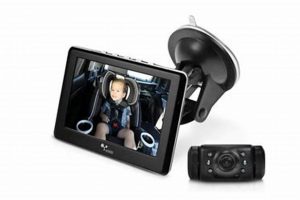
This device allows caretakers to maintain visual contact with an infant or small child seated in a rear-facing car seat. Typically, the system comprises a camera unit mounted in the vehicle, directed at the child, and a monitor positioned within the driver’s view. An example is a small camera that attaches to the headrest, transmitting a video feed to a screen on the dashboard.
Such systems enhance driving safety by minimizing the need for the driver to turn around or divert attention from the road to check on a young passenger. Historically, parents have relied on mirrors, but electronic viewing systems offer a clearer, unobstructed view, particularly in low-light conditions. This technological advancement offers considerable peace of mind.
The following sections will explore the different types of these devices, installation considerations, key features to consider when selecting a suitable model, and their contribution to overall child safety during travel.
Guidance on Utilizing In-Vehicle Infant Viewing Systems
The subsequent information offers practical guidance for effective utilization of systems designed to provide a visual link to infants in rear-facing car seats.
Tip 1: Camera Placement. Optimal positioning of the in-vehicle viewing device is crucial for achieving a clear and comprehensive view of the child. Mount the camera securely to the headrest or another stable location, ensuring that the entire child and the immediate surrounding area are within the field of view.
Tip 2: Monitor Positioning. Strategically place the monitor where it is easily visible to the driver without obstructing the primary driving view. Dashboard mounts or windshield mounts are common choices; however, ensure compliance with local traffic laws regarding obstruction of the windshield.
Tip 3: Illumination Considerations. Assess the system’s performance under various lighting conditions. Features such as infrared night vision can be invaluable for maintaining a clear image during nighttime drives. Be mindful of potential glare from sunlight and adjust the camera angle accordingly.
Tip 4: System Maintenance. Regularly inspect and maintain the device. Check the security of the camera and monitor mounts. Clean the camera lens and monitor screen to ensure a clear image. Replace batteries as needed.
Tip 5: Minimize Distraction. While the device aids in observation, it should not be the sole focus of the driver’s attention. Briefly check the monitor periodically, allocating the majority of attention to the road and surrounding environment. Over-reliance can lead to driver inattentiveness.
Tip 6: Wire Management. Securely manage the camera’s wiring to prevent entanglement or obstruction. Use cable ties or clips to keep wires out of the way and prevent them from becoming a safety hazard.
Tip 7: System Compatibility. Verify compatibility with the vehicle’s electrical system and the specific type of car seat being used. Some systems may require specific power adapters or mounting configurations.
Effective utilization of this type of device, combined with responsible driving habits, contributes significantly to child safety during vehicular transport. These aids serve to improve situational awareness without compromising the driver’s primary task.
The following section will address frequently asked questions regarding these in-vehicle monitoring devices.
1. Image Quality

Image quality is paramount to the utility of an in-vehicle baby monitoring system. A clear, discernible image allows drivers to quickly and accurately assess the child’s condition, ensuring safety without requiring excessive attention diversion.
- Resolution and Clarity
Resolution dictates the level of detail visible in the video feed. Higher resolution cameras produce sharper images, enabling clearer identification of subtle movements, facial expressions, or potential distress signals. For example, a 720p camera provides more detail than a standard definition camera, allowing the driver to more easily distinguish between a sleeping infant and one experiencing difficulty.
- Low-Light Performance
Many driving situations occur in low-light conditions, particularly during evenings or inclement weather. The camera’s ability to maintain image clarity in these circumstances is vital. Infrared (IR) illumination is a common solution, but the quality of the IR emitters and the camera’s sensitivity to IR light determine the effectiveness of the system. Systems lacking adequate low-light performance may render the monitor useless at night.
- Color Accuracy
While not always essential, accurate color representation can aid in identifying potential issues. For instance, a change in skin tone might indicate overheating or other physical distress. A camera with poor color accuracy could mask these subtle but important visual cues. More importantly, color variations are critical to accurate detection of any choking incidents where color changes are an early warning sign.
- Lens Quality and Distortion
The lens quality directly impacts the sharpness and clarity of the image. Inexpensive lenses can introduce distortion, particularly at the edges of the frame. This distortion can make it difficult to accurately assess distances and can also cause eye strain if the driver is constantly trying to compensate for the image anomalies. High-quality lenses minimize distortion, providing a more natural and accurate view.
The facets discussed above contribute directly to the efficacy of a “camera for baby in car.” Prioritizing systems with high resolution, effective low-light performance, accurate color representation, and quality lenses ensures that the device serves its intended purpose: providing a clear and reliable view of the child, thus promoting safer driving practices.
2. Mounting Stability

Mounting stability is a critical design and functional parameter of any in-vehicle infant monitoring system. The operational effectiveness of the “camera for baby in car” is directly contingent on the secure and consistent positioning of both the camera unit and the accompanying monitor. Inadequate mounting stability precipitates a cascade of negative effects, ranging from compromised visibility to potential safety hazards. A camera that vibrates excessively or shifts its position due to inadequate mounting hardware renders the video feed unreliable, diminishing the driver’s ability to accurately monitor the child. Similarly, an unstable monitor mount can obstruct the driver’s view or require frequent readjustment, diverting attention from the primary task of driving. For instance, a suction cup mount that detaches from the windshield during sudden braking can become a projectile within the vehicle, posing a direct risk to occupants.
The significance of mounting stability extends beyond mere image clarity. Consistent camera orientation ensures that the driver develops a reliable mental map of the child’s position relative to the monitor display. Frequent shifts in camera angle necessitate constant recalibration of this mental map, increasing cognitive load and reaction time. Furthermore, robust mounting systems contribute to the overall durability and longevity of the “camera for baby in car.” Vibration and repeated adjustments can stress delicate components, leading to premature failure. Manufacturers often employ various mounting solutions, including screw-on brackets, adhesive pads, and adjustable clamps, each with its own strengths and weaknesses. The selection of an appropriate mounting system should consider the vehicle’s interior design, the frequency of use, and the anticipated environmental conditions.
In summary, mounting stability is an indispensable characteristic of a reliable in-vehicle infant monitoring system. Compromised stability negates the intended safety benefits and introduces potential hazards. Rigorous testing and careful design are essential to ensure that the camera and monitor remain securely positioned under a wide range of driving conditions. The practical understanding of mounting stability facilitates informed purchasing decisions and promotes safer utilization of “camera for baby in car.” Future product development should prioritize innovative mounting solutions that offer enhanced stability, ease of installation, and compatibility with diverse vehicle models.
3. Power Source

The power source for a “camera for baby in car” is a critical determinant of its usability, portability, and overall reliability. The choice of power source dictates installation complexity, operational lifespan, and potential safety considerations.
- Hardwired Connections
Hardwired systems draw power directly from the vehicle’s electrical system, typically through the 12V accessory outlet. This approach ensures a consistent power supply, eliminating the need for battery replacements. However, professional installation may be required to conceal wiring and prevent interference with vehicle electronics. Improper installation can lead to battery drain or electrical damage, rendering the device inoperable and potentially voiding vehicle warranties.
- Battery-Powered Systems
Battery-powered units offer greater installation flexibility as they do not require a connection to the vehicle’s electrical system. These systems may use disposable batteries or rechargeable battery packs. Disposable batteries offer simplicity but can be costly and environmentally unfriendly over time. Rechargeable battery packs require periodic charging, which can be inconvenient if forgotten. Furthermore, battery life varies significantly between models and operating conditions, impacting the system’s continuous availability.
- USB Power
Some “camera for baby in car” models utilize a USB connection for power. These systems can be powered by the vehicle’s USB port or a USB adapter plugged into the accessory outlet. USB power provides a balance between installation simplicity and consistent power supply. However, the available power output from the USB port may be insufficient to operate the camera reliably, especially in models with advanced features like infrared night vision. Furthermore, the USB cable can create a potential entanglement hazard if not properly managed.
- Wireless Transmission Efficiency
Regardless of the primary power source, the efficiency of wireless transmission plays a crucial role in power consumption. Systems that utilize power-efficient transmission protocols, such as Bluetooth Low Energy (BLE) or optimized Wi-Fi, can extend battery life or reduce the power draw from the vehicle’s electrical system. Inefficient wireless transmission can lead to rapid battery depletion or overheating, impacting the system’s performance and longevity.
The choice of power source for a “camera for baby in car” necessitates a careful evaluation of installation complexity, operational reliability, and safety considerations. Hardwired systems offer consistent power but require professional installation. Battery-powered units provide installation flexibility but demand diligent battery management. USB-powered models offer a compromise, but the power output and cable management are crucial factors. Ultimately, the optimal power source depends on individual needs and vehicle configuration, all contributing to the efficacy of the product
4. Viewing Angle
The viewing angle of a “camera for baby in car” is a critical specification directly influencing its effectiveness and the situational awareness it provides. The viewing angle, measured in degrees, dictates the breadth of the area captured by the camera lens. A narrow viewing angle may only capture a limited portion of the child’s car seat, potentially missing critical cues such as head slumping, signs of distress, or dropped objects. Conversely, an excessively wide viewing angle can introduce distortion, making it difficult to accurately assess the child’s condition due to the warped perspective. For example, a camera with a 45-degree viewing angle might only show the child’s head and shoulders, whereas a camera with a 120-degree viewing angle can display the entire car seat area. The relationship between viewing angle and image distortion necessitates careful consideration when selecting a monitoring system.
Optimal viewing angle selection is contingent on car size, car seat position, and camera placement within the vehicle. Smaller cars may necessitate wider viewing angles to capture the entire rear-facing car seat, while larger vehicles might benefit from narrower angles that reduce distortion. Proper camera placement, such as mounting it centrally on the headrest, can maximize the effectiveness of a given viewing angle. Moreover, the intended use case impacts the ideal viewing angle. If the primary objective is to monitor the child’s overall well-being, a wider viewing angle providing a comprehensive view of the car seat is preferable. If the focus is on observing specific details, such as facial expressions, a narrower viewing angle with higher image clarity might be more suitable. The balance between field of view and image resolution should be considered.
In summary, the viewing angle is not merely a technical specification but a fundamental parameter dictating the practical utility of a “camera for baby in car”. Its proper selection, in consideration of vehicle dimensions, camera placement, and intended use, is paramount to maximizing its effectiveness in promoting child safety and parental peace of mind. Challenges remain in developing adaptive viewing angle technology that automatically adjusts based on vehicle and car seat configuration. However, a thorough understanding of viewing angle dynamics is essential for making informed purchasing decisions and optimizing the functionality of in-vehicle baby monitoring systems.
5. Infrared Capability

Infrared (IR) capability represents a fundamental feature in modern “camera for baby in car” systems, enhancing their utility under diminished lighting conditions. Its incorporation addresses a crucial limitation of standard cameras, enabling continuous and effective monitoring during nighttime travel or in dimly lit vehicle interiors. The presence or absence of effective IR functionality can significantly impact the system’s overall value and its contribution to child safety.
- Nighttime Visibility Enhancement
The primary role of IR capability is to provide clear visibility in the absence of ambient light. Standard cameras rely on visible light to capture images, rendering them ineffective in darkness. IR cameras, however, emit infrared light, which is invisible to the human eye but detectable by the camera’s sensor. This allows the camera to create a grayscale image, effectively “seeing” in the dark. A real-world example is a system that allows a parent to monitor a sleeping infant during a late-night drive without having to turn on the car’s interior lights, which could disturb the child.
- Wavelength Selection and Image Clarity
The specific wavelength of infrared light used by the camera affects the clarity and range of the resulting image. Different IR wavelengths penetrate materials differently, and the choice of wavelength influences the amount of detail captured. Some systems use near-infrared (NIR) LEDs, while others utilize far-infrared. Systems with poorly selected or implemented IR wavelengths may produce blurry or washed-out images, diminishing their effectiveness. For example, a system using an inappropriate wavelength might produce glare from the car seat fabric, obscuring the child’s features.
- IR LED Configuration and Range
The number, arrangement, and power of the IR LEDs (light-emitting diodes) determine the effective range of the infrared illumination. A system with insufficient LEDs might only illuminate a small portion of the car seat, leaving the child’s face or body in shadow. Conversely, an overabundance of LEDs can create hotspots or glare, degrading image quality. The arrangement of the LEDs is also important; evenly distributed LEDs provide more uniform illumination than a concentrated cluster. An example is a system with strategically placed LEDs that provide consistent illumination across the entire field of view, ensuring that the child’s face is always visible.
- Automatic vs. Manual IR Activation
Some “camera for baby in car” systems automatically activate the IR illumination when ambient light levels fall below a certain threshold, while others require manual activation. Automatic activation is generally more convenient, as it eliminates the need for the driver to manually adjust the settings. However, manual activation provides greater control, allowing the driver to disable the IR illumination if it is causing glare or other issues. An example of automatic activation is a system that seamlessly switches to IR mode as twilight approaches, ensuring continuous monitoring without driver intervention.
The interplay between these facets of IR capability directly impacts the practical utility of a “camera for baby in car”. Systems with well-designed IR illumination provide clear, consistent visibility under low-light conditions, enhancing safety and reducing parental anxiety. Conversely, poorly implemented IR functionality can render the system ineffective or even create new safety hazards. Therefore, potential purchasers should carefully evaluate the IR capabilities of any “camera for baby in car” system before making a decision, considering its impact on overall performance and safety.
6. Wireless Range

The wireless range of a “camera for baby in car” directly impacts the system’s reliability and usability. This specification dictates the maximum distance between the camera unit and the receiving monitor within which a stable video and audio signal can be maintained. Insufficient wireless range results in signal degradation, video lag, or complete signal loss, rendering the monitoring system ineffective. The causes of limited wireless range can stem from several factors, including signal interference from other electronic devices, obstructions within the vehicle (such as metal components or tinted windows), and the inherent limitations of the wireless transmission technology employed. For instance, a system with a 2.4 GHz wireless connection may experience interference from other Bluetooth devices or Wi-Fi routers in close proximity, leading to intermittent signal loss.
The importance of adequate wireless range is amplified in larger vehicles, where the distance between the rear-facing car seat and the driver’s viewing position is greater. Furthermore, certain vehicle designs, such as those with thick pillars or insulated compartments, can impede wireless signal propagation. Real-life examples include instances where the video feed becomes choppy or completely disappears when driving through tunnels or areas with dense electronic activity. Understanding the practical significance of wireless range allows consumers to make informed purchasing decisions, selecting systems that are appropriately suited for their vehicle type and driving environment. Systems employing more robust wireless technologies, such as digital wireless or those operating on less congested frequency bands, typically offer superior range and reliability.
In conclusion, wireless range is a critical performance parameter for any “camera for baby in car”. Signal degradation or loss due to insufficient range can compromise the system’s ability to provide a reliable visual and auditory connection to the child. Challenges remain in mitigating signal interference and optimizing wireless transmission within the confined and often electronically noisy environment of a vehicle. However, prioritizing systems with proven wireless range and robust signal integrity is essential for ensuring consistent and dependable monitoring, a key aspect of child safety during travel.
7. Monitor Size
Monitor size is a critical ergonomic and functional consideration within “camera for baby in car” systems. The dimensions of the display screen directly influence the ease with which a driver can quickly and accurately assess the child’s well-being without undue distraction from the road.
- Visual Acuity and Detail Recognition
Smaller monitors, typically less than 4 inches diagonally, may compromise the driver’s ability to discern subtle details in the video feed. Facial expressions, minor adjustments in body posture, or the presence of foreign objects near the child may be missed. Conversely, larger monitors, exceeding 7 inches, can present a more comprehensive view, facilitating easier recognition of key details. For example, a larger monitor could clearly display whether a pacifier has fallen from the child’s mouth, a detail potentially overlooked on a smaller screen. However, excessively large monitors can obstruct the driver’s field of view, posing a safety hazard. The optimal size balances detail recognition with minimal obstruction.
- Mounting Constraints and Vehicle Compatibility
The physical dimensions of the monitor must be compatible with the vehicle’s interior. Larger monitors may not be easily accommodated on the dashboard or windshield of smaller cars without obstructing critical controls or gauges. Conversely, smaller monitors can be more discreetly mounted, but may require the driver to lean forward or squint to view the display clearly. Mounting options and vehicle-specific constraints often dictate the practical upper limit of monitor size. An instance is a compact car where a 7-inch monitor significantly impairs visibility, forcing the driver to choose a smaller, less detailed display.
- Driver Fatigue and Cognitive Load
Prolonged viewing of a small monitor can induce eye strain and driver fatigue, particularly during long journeys. The constant effort required to focus on a diminutive display increases cognitive load, diverting attention from the primary task of driving. Larger monitors, while providing greater detail, can also contribute to visual overload if they display excessive information or are positioned too close to the driver’s eyes. The ideal monitor size minimizes eye strain and cognitive burden, promoting safer and more comfortable driving. For instance, a driver using a poorly positioned small monitor for several hours may experience significant eye fatigue and reduced reaction time.
- Power Consumption and System Integration
Larger monitors generally consume more power than smaller ones, potentially impacting battery life in systems that rely on independent power sources. The monitor’s power requirements must be carefully considered in relation to the overall system’s power budget. Furthermore, the monitor’s integration with other system components, such as the camera unit and wireless transmitter, must be seamless to ensure reliable performance. A larger monitor with high power consumption may require a more robust power supply, adding to the system’s cost and complexity. Integration challenges can arise if the monitor is incompatible with the camera’s video output resolution or frame rate.
The interplay between visual acuity, mounting constraints, driver fatigue, and power consumption underscores the importance of judiciously selecting a monitor size that aligns with the vehicle’s characteristics, the driver’s visual needs, and the “camera for baby in car” system’s capabilities. A carefully chosen monitor size maximizes the system’s effectiveness in promoting child safety while minimizing potential distractions and ergonomic concerns.
Frequently Asked Questions
The following addresses common inquiries regarding in-vehicle infant monitoring systems, clarifying their functionality and practical application.
Question 1: Is a “camera for baby in car” a substitute for direct visual checks?
No. This system is designed to augment, not replace, periodic direct visual checks. The driver must still ensure the child’s well-being during stops and remain vigilant for auditory cues of distress.
Question 2: What is the expected lifespan of a “camera for baby in car”?
The lifespan varies depending on usage frequency, environmental conditions, and build quality. Higher-quality units, properly maintained, can last several years. Lower-end models may exhibit premature component failure. Warranty periods provide an indication of expected durability.
Question 3: Does the use of a “camera for baby in car” void any vehicle warranties?
In most cases, simple installation of a camera system will not void the vehicle warranty. However, hardwiring the system into the vehicle’s electrical system could potentially affect the warranty, depending on the vehicle manufacturer’s policies. Consult the vehicle’s warranty documentation or contact the manufacturer for clarification.
Question 4: Can a “camera for baby in car” system be used in all types of vehicles?
Most systems are designed to be compatible with a wide range of vehicle types. However, certain mounting configurations may be unsuitable for specific vehicle designs. Verify compatibility before purchase and installation. Consider factors such as headrest design, windshield angle, and dashboard space.
Question 5: Is a “camera for baby in car” susceptible to hacking or unauthorized access?
Systems employing secure wireless protocols are less vulnerable to unauthorized access. However, any device connected to a wireless network presents a potential security risk. Select systems with robust security features, such as encryption, and regularly update the firmware to mitigate vulnerabilities.
Question 6: What is the ideal placement of the monitor within the vehicle for optimal viewing and safety?
The monitor should be positioned within the driver’s field of view without obstructing the road. Common mounting locations include the dashboard, windshield, or center console. Adhere to local traffic laws regarding obstruction of the windshield. The monitor should be easily visible with minimal head movement.
These FAQs serve to clarify key aspects of in-vehicle infant monitoring systems. Appropriate utilization enhances safety; yet reliance on technology must not overshadow direct observation or safe driving practices.
The subsequent section provides a summary of key considerations.
Camera for Baby in Car
The preceding discussion has explored the multifaceted nature of the “camera for baby in car,” encompassing its functionality, technical specifications, optimal utilization, and prevalent inquiries. Image quality, mounting stability, power source considerations, viewing angle, infrared capability, wireless range, and monitor size collectively determine the system’s efficacy in promoting child safety during vehicular transport. Careful consideration of these elements ensures informed purchasing decisions and responsible integration of the technology into driving practices.
The “camera for baby in car,” while a valuable tool, should be regarded as an adjunct to, not a replacement for, responsible driving and direct parental observation. Its ultimate utility lies in its capacity to enhance situational awareness without compromising the driver’s primary focus on the road. Continuous technological refinement, coupled with heightened consumer awareness, will shape the future of in-vehicle child monitoring, further enhancing safety and minimizing preventable risks. Prioritize safety and informed decision-making in the selection and application of these systems.