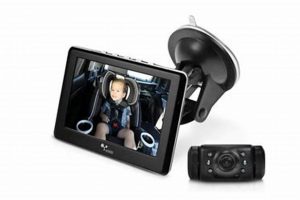
A vehicular adaptation of in-home audio and video surveillance technology permits remote observation of infants or children in vehicles. This technology often comprises a camera installed in the vehicle, typically directed towards the child’s seating position, coupled with a receiver unit for parental viewing. The system provides a means to visually and audibly monitor a childs well-being while the vehicle is in motion, similar to how an in-home device functions. For example, parents can observe if a child has become unrestrained from their car seat or is experiencing distress.
Such systems address safety and peace-of-mind concerns for caregivers. These devices may mitigate distractions arising from parental attempts to visually check on children while driving, potentially reducing the risk of accidents. Historically, parents would frequently glance into the rearview mirror, or even turn around, to observe their children. Modern solutions leverage technology to offer a more comprehensive and less disruptive monitoring method.
The following sections will discuss the different types of systems available, their specific features, installation considerations, and potential drawbacks, providing a comprehensive overview of this technology.
Considerations for Utilizing a Mobile Infant Monitoring System
The utilization of an in-vehicle infant monitoring system necessitates careful planning and execution to ensure both safety and efficacy. The following tips provide guidance for the successful deployment and responsible use of such a device.
Tip 1: Assess System Compatibility: Prior to purchase, verify the monitoring system’s compatibility with the vehicle’s electrical system and the specific child safety seat in use. Improper installation may compromise the functionality of both the monitoring system and the child restraint.
Tip 2: Prioritize Professional Installation: To ensure optimal performance and adherence to safety standards, consider professional installation of the monitoring system. Incorrect wiring or camera placement can negatively impact the system’s utility and create potential hazards.
Tip 3: Establish Optimal Camera Positioning: Experiment with different camera angles and positions to achieve a clear and comprehensive view of the child. Avoid placements that may obstruct the driver’s visibility or create glare issues.
Tip 4: Familiarize with System Functionality: Before embarking on a journey, thoroughly familiarize with all features and controls of the monitoring system. This includes understanding the display interface, volume adjustments, and any available zoom or night vision capabilities.
Tip 5: Practice Regular System Checks: Conduct routine inspections of the monitoring system to confirm its proper functioning. Verify the camera’s focus, the clarity of the display, and the integrity of all wiring connections. Address any malfunctions promptly.
Tip 6: Acknowledge and Mitigate Distraction Potential: While intended to enhance safety, over-reliance on the monitoring system can potentially distract the driver. Establish clear parameters for when and how frequently to consult the display to minimize distractions.
Tip 7: Observe Privacy Considerations: Be mindful of privacy implications when using a vehicle monitoring system. Avoid capturing or storing footage without appropriate consent, particularly in shared vehicles or public spaces.
Adhering to these recommendations will promote the safe and effective use of an in-vehicle monitoring device, thereby contributing to a safer and more peaceful driving experience for both the caregiver and the child.
The subsequent discussion will delve into the comparative analysis of various monitoring system models, highlighting their respective strengths and weaknesses.
1. Installation Complexity

Installation complexity significantly impacts the accessibility and utility of vehicular infant monitoring systems. The ease or difficulty of setting up the system directly affects the users ability to properly implement and maintain the device. Complex installation procedures may deter potential buyers or lead to improper setup, potentially compromising the system’s effectiveness and creating safety hazards. For example, a system requiring hardwiring to the vehicle’s electrical system demands specialized knowledge and tools, potentially necessitating professional installation, thereby increasing the overall cost and complexity.
Conversely, systems with simpler, plug-and-play installation processes offer greater convenience and user-friendliness. These typically involve mounting the camera and display unit using adhesive or suction cups and powering the system through a cigarette lighter adapter or USB port. However, even seemingly simple installations require careful attention to detail to ensure secure mounting, proper camera positioning, and avoidance of obstructions to the driver’s vision. A loosely mounted camera, for instance, could become a projectile in the event of a sudden stop, posing a risk to the child.
Ultimately, the relationship between installation complexity and vehicular infant monitoring is critical. It dictates who can effectively use the device, how reliably it functions, and whether it contributes to or detracts from overall safety. Manufacturers should strive for a balance between feature-rich functionality and ease of installation to maximize user adoption and ensure optimal performance.
2. Camera Field-of-View

The camera’s field-of-view is a critical specification in the context of vehicular infant monitoring systems. It dictates the spatial extent of the area captured by the camera and, consequently, the caregiver’s ability to observe the child’s activities and well-being. The field-of-view directly influences the comprehensiveness of the monitoring capability.
- Area Coverage
The field-of-view determines how much of the rear seating area is visible to the driver. A wider field-of-view allows for simultaneous monitoring of multiple children or comprehensive observation of a single child’s movements. For example, a wide-angle lens may capture the entire back seat, while a narrow lens focuses solely on the child’s face. Limited area coverage may miss critical events like a child unbuckling their seatbelt or experiencing distress outside the camera’s limited view.
- Distortion and Image Quality
Wider fields-of-view often result in image distortion, particularly at the edges of the frame. The trade-off between area coverage and image quality must be considered. Excessive distortion can hinder accurate interpretation of the observed scene. Rectilinear lenses, which minimize distortion, may be preferred over fisheye lenses, even though the latter offers a wider viewing angle. Clarity and resolution are maintained at the expense of capturing everything.
- Placement Considerations
The optimal camera placement is contingent on the camera’s field-of-view. A narrower field-of-view necessitates more precise positioning to capture the desired area, while a wider field-of-view offers greater flexibility in placement. For example, a camera with a narrow field-of-view may need to be mounted directly above the child’s seat, whereas a wide-angle camera could be positioned on the dashboard or headrest.
- Night Vision Capabilities
The effectiveness of night vision features is influenced by the camera’s field-of-view. A wider field-of-view requires more powerful infrared illumination to adequately illuminate the entire scene. Insufficient illumination can result in a dimly lit or grainy image, compromising the utility of the night vision function. Therefore, an infrared camera should be equipped with a field-of-view sufficient to cover the area the driver wishes to view at night.
The selection of an appropriate camera field-of-view for a vehicular infant monitoring system requires careful consideration of the vehicle’s interior layout, the number of children to be monitored, and the desired image quality. Balancing these factors is essential for ensuring the system effectively contributes to child safety and caregiver peace of mind.
3. Wireless Interference
Wireless interference poses a significant challenge to the reliable operation of vehicular infant monitoring systems. These systems, often relying on wireless transmission to relay audio and video from the camera to the receiver unit, are susceptible to disruption from various sources. Common causes include other electronic devices operating within the same frequency band, such as Bluetooth devices, Wi-Fi routers, and even other baby monitors. The effect of this interference can range from intermittent signal loss to complete system failure, compromising the caregiver’s ability to effectively monitor the child. For example, a parent traveling through an area with high Wi-Fi density, such as a commercial district, might experience frequent video dropouts, rendering the system temporarily unusable. The practical significance of understanding wireless interference lies in its potential to undermine the very purpose of these devices: to provide a reliable and continuous view of the infant’s well-being.
Mitigating wireless interference involves several strategies. Manufacturers often incorporate frequency-hopping spread spectrum (FHSS) or digital enhanced cordless telecommunications (DECT) technologies to minimize the impact of interference by rapidly switching between different frequency channels. Users can also take steps to reduce interference by keeping the receiver unit away from other electronic devices and ensuring a clear line of sight between the camera and receiver. In urban environments, where interference is more prevalent, choosing a system that operates on a less congested frequency band may improve performance. Furthermore, shielding cables and using ferrite beads can help reduce electromagnetic interference. Some systems offer adjustable transmission power settings, allowing users to optimize the signal strength and minimize interference with other devices.
In summary, wireless interference is a crucial consideration for anyone considering the use of a vehicular infant monitoring system. Understanding the potential sources of interference and the strategies for mitigating its effects is essential for ensuring the system operates reliably and effectively. The ongoing challenge for manufacturers is to develop systems that are both robust against interference and user-friendly, providing caregivers with a consistent and dependable monitoring solution. Addressing this concern directly contributes to the peace of mind and safety that these systems are intended to provide.
4. Power Consumption

Power consumption is a key design and operational parameter for vehicular infant monitoring systems. Its importance stems from the constraints of automotive electrical systems and the need for continuous, reliable monitoring. Efficient power management is essential to minimize strain on the vehicle’s battery and ensure the system functions effectively throughout a journey.
- Battery Drain
High power consumption can lead to rapid battery drain, particularly when the vehicle is stationary and the engine is not running. This is especially critical for systems powered directly from the vehicle’s battery via the 12V auxiliary power outlet. Excessive drain can result in a dead battery and inability to start the vehicle. For example, leaving a system with a power-hungry display running for an extended period while parked could deplete the battery below starting voltage. Proper system design and usage habits are therefore paramount to avoid such scenarios. Manufacturers are now employing sleep modes to mitigate this issue.
- System Components
The various components of an infant monitoring system contribute differently to the overall power consumption. The camera, particularly those with infrared night vision capabilities, tends to be the most significant power draw. The display unit, especially those with larger screens and higher brightness levels, also consumes substantial power. Wireless transmitters and receivers, essential for relaying audio and video, contribute to the overall power load as well. Effective system design optimizes the power efficiency of each component, balancing performance with energy conservation. For example, newer cameras use more energy-efficient sensors to help with energy consumption.
- Power Source
The power source significantly influences the system’s impact on the vehicle’s electrical system. Systems that operate solely on the vehicle’s battery pose the greatest risk of battery drain. Systems with integrated rechargeable batteries or the option to use external power sources offer greater flexibility and reduce the risk of depleting the vehicle’s battery. However, relying on integrated batteries introduces the need for periodic charging, which can be inconvenient. A hybrid approach, where the system draws power from the vehicle but can switch to battery power when the engine is off, represents a balanced solution.
- Wireless vs. Wired Systems
Wireless and wired systems exhibit different power consumption characteristics. Wireless systems, while offering greater installation flexibility, typically consume more power due to the energy required for wireless transmission. Wired systems, which directly connect the camera and display unit, generally exhibit lower power consumption. However, wired systems can be more challenging to install and may require routing cables through the vehicle’s interior. The choice between wireless and wired depends on the user’s priorities regarding installation convenience versus power efficiency. These different options must be considered when buying the system.
In conclusion, power consumption is a vital consideration in the design and use of vehicular infant monitoring systems. Efficient power management not only minimizes the risk of battery drain but also enhances the system’s overall practicality and user-friendliness. Manufacturers are continually striving to optimize power efficiency through advancements in component design and power management strategies. Consumers, in turn, should be mindful of power consumption when selecting and using these systems, adopting habits that promote both safety and energy conservation.
5. Display Size

Display size is a defining characteristic of vehicular infant monitoring systems, directly influencing the user’s ability to effectively observe and interpret visual information relayed from the camera. It is a critical factor in determining the overall utility and user experience of these devices, mediating the balance between visibility and driver distraction.
- Information Visibility
The primary function of the display is to present a clear and easily interpretable visual representation of the child’s seating area. A larger display size generally facilitates improved visibility of details, such as the child’s facial expressions, body posture, and any objects within reach. Conversely, a smaller display may compromise the ability to discern subtle cues, potentially hindering the prompt identification of distress or unsafe situations. For example, discerning whether an infant is choking requires the ability to clearly see their face; a small display might obscure such crucial details.
- Driver Distraction
While a larger display offers enhanced visibility, it also presents a greater potential for driver distraction. A prominent screen positioned within the driver’s field of vision can divert attention from the road, increasing the risk of accidents. The optimal display size represents a compromise between visibility and minimizing distractions. Ergonomic placement of the display unit is also critical; mounting it in a peripheral location, such as on the dashboard’s upper edge, can help reduce direct line-of-sight obstruction. Distraction will be the main safety issue with these systems.
- Mounting and Integration
The physical dimensions of the display unit also impact its ease of mounting and integration within the vehicle’s interior. Larger displays may be more difficult to securely mount without obstructing the driver’s vision or interfering with other vehicle controls. Smaller displays offer greater flexibility in placement but may sacrifice visibility. The design and mounting mechanism must prioritize safety and minimize any potential interference with vehicle operation. A large, poorly mounted display could become a projectile in the event of a collision.
- Technological Considerations
Technological advancements in display technology affect the relationship between display size and image quality. Higher resolution displays can render sharper and more detailed images even at smaller sizes, mitigating some of the limitations of smaller screens. Factors such as display brightness, contrast ratio, and viewing angle also contribute to the overall viewing experience, regardless of display size. An advanced display technology will allow you to get the most out of this system.
In conclusion, the display size is a multifaceted aspect of vehicular infant monitoring systems, influencing visibility, driver distraction, mounting considerations, and the impact of technological advancements. Selecting an appropriate display size necessitates careful consideration of these factors to achieve a balance between safety, functionality, and user experience. Ultimately, the goal is to provide caregivers with a reliable and minimally intrusive means of monitoring their children while driving, without compromising road safety.
Frequently Asked Questions Regarding In-Vehicle Infant Monitoring Systems
The following questions address common concerns and misconceptions regarding vehicular infant monitoring systems. These answers aim to provide clarity and promote informed decision-making.
Question 1: Are vehicular infant monitoring systems legal to use?
Legality varies by jurisdiction. While the act of monitoring children is generally permissible, restrictions may apply to the placement of cameras and recording of audio or video, particularly in vehicles used for commercial purposes or ride-sharing. Consultation with local laws is advised.
Question 2: Can these systems completely replace physical checks on the child?
No. While these systems offer visual and auditory monitoring, they should not replace periodic physical checks. These systems are not foolproof and may be subject to technological failures or limitations in viewing angles.
Question 3: How does installation of such a system affect the vehicle’s warranty?
Improper installation, particularly involving modifications to the vehicle’s electrical system, may void portions of the warranty. Professional installation by a qualified technician is recommended to minimize this risk.
Question 4: What is the expected lifespan of a vehicular infant monitoring system?
Lifespan varies depending on the quality of components and frequency of use. Expect a typical lifespan of 3-5 years. Exposure to extreme temperatures and vibrations within the vehicle can accelerate wear and tear.
Question 5: Are these systems vulnerable to hacking or unauthorized access?
Systems employing wireless transmission are potentially vulnerable to hacking. Selecting systems with robust encryption and regularly updating firmware can mitigate this risk. Wired systems are generally less susceptible to unauthorized access.
Question 6: Can these systems be used in conjunction with other child safety devices?
Yes. These systems are intended to complement, not replace, other child safety devices such as car seats and seatbelt extenders. Ensure that the monitoring system’s installation does not interfere with the proper functioning of any safety devices.
In summary, vehicular infant monitoring systems offer benefits but are subject to legal, practical, and security considerations. Responsible use and proper installation are crucial for maximizing effectiveness and minimizing potential risks.
The subsequent sections will delve into case studies involving the application of vehicular infant monitoring systems in different family scenarios.
Baby Monitor Car
This exploration has underscored the multifaceted nature of vehicular infant monitoring systems, commonly known as “baby monitor car.” From installation complexities and camera field-of-view considerations to the challenges posed by wireless interference and the imperative of efficient power consumption, the analysis has illuminated the critical factors influencing the effective deployment and utilization of these devices. Furthermore, the examination of display size highlighted the delicate balance between visibility and driver distraction. The inquiry has consistently prioritized a serious and informative tone, emphasizing the practical implications and potential challenges associated with this technology.
Given the inherent responsibilities associated with child passenger safety, the decision to employ a “baby monitor car” system should be approached with diligence and informed awareness. While offering potential benefits in terms of parental reassurance and enhanced monitoring capabilities, it is essential to recognize the limitations of technology and to prioritize responsible driving practices. The continuous pursuit of technological advancements and the adherence to stringent safety standards are crucial for ensuring that these systems contribute positively to the well-being of children in transit. A commitment to informed consumer choices, coupled with ongoing research and development, is essential for navigating the evolving landscape of vehicular infant monitoring solutions.